Turnkey Pellet Feed Mill Construction & Machinery | Atlas Yem
News

Turnkey Pellet Feed Mill Construction
Turnkey Pellet Feed Mill Construction: Engineering the Future of Global Feed Production
The global livestock industry demands absolute operational efficiency, structural resilience, and cost optimization. At the core of this demand lies the engineering philosophy of Atlas Yem, a leading power in feed technologies and industrial machinery manufacturing since 2002. Based in Konya, Turkey, Atlas Yem designs and delivers heavy-duty, integrated turnkey feed mill construction projects that eliminate production bottlenecks, minimize total cost of ownership (TCO), and maximize raw material bioavailability.
What is a Turnkey Pellet Feed Mill?
A turnkey pellet feed mill refers to a fully automated, integrated industrial plant designed, manufactured, and commissioned by a single engineering entity, encompassing every stage of production from raw material intake to final automated packaging.
Unlike fragmented setups, a true turnkey pellet feed mill acts as a synchronized ecosystem. Every mechanical component, electrical circuit, and automation layer communicates flawlessly to achieve maximum uptime and precise rasyon preparation.
Core Components of High-Performance Feed Mill Machinery
Modern feed mill machinery must be built for structural longevity and extreme operational stability. Atlas Yem designs its product portfolio across distinct process-oriented sub-systems to guarantee 24/7 reliability.
1. Raw Material Preparation & Crushing Systems
The production line begins with industrial crushing systems. High-speed hammer mills process grains to exact micron levels, preparing the material for precise dosing.
2. Homogeneous Mixing & Liquid Additive Systems
Nutritional consistency requires absolute homogeneity. Atlas Yem’s dual-shaft and horizontal ribbon mixers achieve CV (Coefficient of Variation) levels below industry standards, integrating liquid additives with surgical precision.
3. High-Pressure Pelletizing Systems
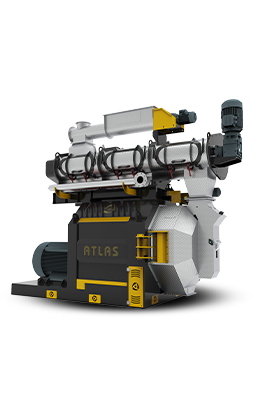
The pellet mill is the heart of the facility. Atlas Yem’s geared pellet press models deliver up to 15% more power transmission efficiency compared to traditional belt-driven systems. Integrated conditioning units ensure perfect steam infusion and starch gelatinization, directly optimizing the Pellet Durability Index (PDI).
The Forum Debate: Pellet Mill Power Transmission — Gear-Driven vs. Belt-Driven Systems
In global engineering forums, the most debated topic among plant managers and procurement experts revolves around the mechanical efficiency of pellet mill drivetrains: Gear-Driven vs. Belt-Driven Pellet Presses.
The Technical Confrontation
-
Belt-Driven Systems: Historically favored for low initial capital expenditure (CAPEX) and simple maintenance. However, they suffer from slippage under high torque conditions, leading to frictional energy loss, frequent belt replacements, and fluctuating PDI quality.
-
Gear-Driven Systems: Atlas Yem’s engineering standard utilizes heavy-duty internal gearing. This setup eliminates slippage entirely, providing continuous, uniform torque transfer to the die.
The Verdict for 2026 Operations
For industrial-scale operations, the consensus is clear: gear-driven systems drastically reduce total cost of ownership (TCO). While the initial investment is higher, the 15% increase in power transmission efficiency and the elimination of unplanned downtime for belt adjustments allow investors to achieve an equipment payback period far below the sector average.
Reducing Energy Consumption and TCO in Feed Production
Energy consumption represents the largest overhead in industrial feed production. Atlas Yem addresses this challenge through proactive mechanical design and smart automation:
-
20% Energy Reduction: By integrating new-generation motor drives and optimized mechanical dynamics, Atlas Yem systems slash electricity consumption per ton produced.
-
ISO 9001:2015 Quality Standards: Every single machine undergoes rigorous load testing and vibration analysis simulating harsh field conditions before dispatch, eliminating human-induced errors.
-
Zero-Waste Recycling Integration: In-plant logistics are reinforced with built-in recycling technologies (shredders, trommel sieves) to recover off-spec pellets and process dust, transforming potential waste back into high-quality raw material.
People Also Ask (PAA)
What is the average capacity of a commercial pellet feed mill?
Commercial pellet feed mills typically range from 5 tons per hour (TPH) to over 50 TPH for large-scale industrial operations. The capacity depends heavily on the configuration of the hammer mills, the diameter of the pellet press die, and the efficiency of the cooling line.
How does pellet durability index (PDI) affect feed quality?
PDI measures the physical integrity of pellets during transport and handling. A low PDI results in high percentages of dust and fines, leading to selective feeding, nutritional waste, and increased respiratory issues in livestock. Proper steam conditioning is vital to achieving a high PDI.
What is the difference between flake technology and pelleting?
Flake technology uses steam chest towers to soften the cell membrane of grains before passing them through heavy-duty flaking mill waltzes to create flat flakes, increasing starch digestibility to over 90%. Pelleting compresses conditioned ground mash through a die to form cylindrical pellets.
Frequently Asked Questions (FAQ)
1. What parameters determine turnkey feed mill construction costs?
Turnkey feed mill construction costs are determined by hourly production capacity (TPH), level of automation (PLC/SCADA integration), raw material storage volume (silo capacities), and the inclusion of specialized lines like flaking mills or pet food extruders.
2. Why is a gear-driven pellet press superior to belt-driven alternatives?
A gear-driven pellet press eliminates mechanical belt slippage under high-torque conditions. This ensures continuous power transmission, reduces energy loss by up to 15%, provides consistent compression for higher PDI, and requires fewer maintenance interventions.
3. How does Atlas Yem optimize the total cost of ownership (TCO)?
We model all maintenance, spare parts, and energy expenses during the initial project design phase. By combining energy-efficient motor drivers, zero-tolerance ISO 9001:2015 manufacturing quality, and robust mechanical components, we minimize long-term operating expenses (OPEX).
4. Can your feed mill machinery handle cattle, poultry, and pet food simultaneously?
Yes. While the core process flow remains similar, Atlas Yem designs multi-purpose lines with customizable conditioning parameters, variable-speed dies, and distinct dosing setups tailored to the unique nutritional and structural requirements of cattle, poultry, or pet food rasyons.
5. What post-installation support does Atlas Yem provide?
Atlas Yem provides full-scale field commissioning, operator training, mechanical performance verification with parameter logging, and proactive technical support, alongside guaranteed spare parts availability to prevent unplanned operational downtime.
If you enjoyed our content "Turnkey Pellet Feed Mill Construction" please visit our News page.
For more information, please contact us.