Export-Oriented Feed Mill Installation | Atlas Yem
News

Export-Oriented Feed Mill Installation
Global Engineering in Export-Oriented Feed Mill Installation: Atlas Yem
When the production vision of an agriculture and livestock enterprise transcends local borders to compete in the global market, its facility infrastructure must be robust enough to carry this international weight. Export-oriented feed mill installation demands a much sharper engineering discipline and zero-error tolerance compared to the construction of a standard plant. Exporting to international markets means uninterrupted tonnage, millimetric ration homogeneity, high pellet hardness to withstand transoceanic logistics, and full compliance with international certifications (ISO, GMP+).
Setting industrial standards in feed technologies since 2002, Atlas Yem combines its Konya-based manufacturing power with global engineering norms to transform your export goals into a rational operational architecture. We do not merely sell a feed machine; we build turnkey feed mill ecosystems that optimize your enterprise's production cost per ton and completely eliminate capacity bottlenecks.
Export-Oriented Feed Mill Installation and Operational Performance Rubric
The cornerstone of success in international trade is a "sustainable standard." A feed production plant targeting exports must guarantee the identical physical and nutritional quality in every single shift. Atlas Yem engineering secures this quality standard right from the facility's design stage through the Total Cost of Ownership (TCO) rubric.
The energy savings of up to 20% we achieve through new-generation motor drives and optimized mechanical designs provide your business with an unwavering advantage in global price competition. Our systems eliminate capacity bottlenecks, ensuring strict adherence to the deadlines of your export orders.
Subsystem Integrations Determining Quality in Exports
The fundamental factor determining export quality is the flawless synchronization of the 11 core sub-categories in the production line:
-
Crushing and Dosing Systems: Rational particle size and precise dosing. The error-free addition of micro-components in export formulas is a critical rubric criterion for cross-border food safety inspections.
-
Mixing Systems: Our twin-shaft and horizontal ribbon mixer alternatives provide 98% and above homogeneity in every gram of the target product.
-
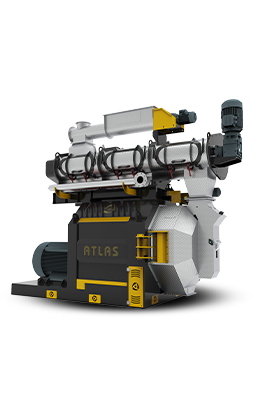
Pelletizing and Ventilation (Cooling) Systems: Products compressed by high-pressure pelletizing systems must possess the physical hardness to withstand long container journeys. Our counter-flow ventilation systems rapidly stabilize pellet moisture, zeroing out the risk of mold.
Most Discussed Topic in Global B2B Forums: PDI (Pellet Durability Index) vs. Production Speed in Exports? The most intense debate in international forums featuring industrial feed producers is this: "How do we prevent pellets from crumbling into dust (low PDI) during intercontinental shipments while producing at high capacities?" In exports, feed that has turned to dust directly causes returns and loss of prestige. As Atlas Yem, we offer a sharp solution to this critical dilemma: You do not have to compromise between capacity and quality. By rationally utilizing steam with our advanced conditioner units, we maximize starch gelatinization; thus, we produce export-standard pellets with a near-zero crumbling rate even at the highest tonnages.
The Power of Flake and Recycling Technologies in the Global Market
Offering value-added products in export markets directly increases your business's profit margin. Moving beyond standard rations, Atlas Yem enables you to offer highly digestible premium products to the cattle sector with flake technologies. Conditioning grains in steam towers (Steam Chest) and crushing them in heavy-duty rollers (Flaking Mill) pushes starch digestibility above 90%, adding an unrivaled product line to your export portfolio.
Furthermore, the "zero waste" principle is not a luxury but an operational necessity in high-capacity export facilities. Our integration of recycling technologies (Shedder, recycling crusher machine, package opening machine, and trommel sieve) ensures that defective pellets are reintroduced into the process without compromising raw material purity. This rational intervention zeroes out raw material waste, increasing your facility's cost resilience in the global market.
Zero-Tolerance Quality Rubric Registered with ISO 9001:2015
In our export-oriented feed mill installation projects, quality is not a department but a reflex embedded in every second of the production process. Atlas Yem’s 4-stage Quality Control Rubric (Input control, CNC inspections, load/vibration analyses, and field commissioning logs) guarantees the infrastructure of the products you will export. Working with Atlas Yem transforms your enterprise from being just a manufacturer into an unwavering authority in the global supply chain.
If you enjoyed our content "Export-Oriented Feed Mill Installation" please visit our News page.
For more information, please contact us.
F.A.Q. (Frequently Asked Questions)
1. What is the main difference between export-oriented feed mills and local facilities?
Export facilities must possess international traceability norms (full automation PLC/SCADA), incorporate advanced cooling systems for a long shelf life, and reach a high PDI (Pellet Durability Index) value resistant to long container shipments.
2. Are the facilities established by Atlas Yem compliant with international certifications?
Yes. We manufacture under ISO 9001:2015 standards. The mechanical and automation infrastructure of our facilities is built turnkey, in full compliance with global food safety and occupational health standards (such as CE norms).
3. Does spare parts supply create a bottleneck for exporting companies?
No. Atlas Yem eliminates the risks of unplanned downtime by providing uninterrupted, fast, and original spare parts support to all the facilities it has established via its global logistics network.
People Also Ask (P.A.A.)
-
What is the importance of automation in exporting feed mills?
-
How to increase the Pellet Durability Index (PDI)?
-
How is the cost of turnkey feed mill installation calculated?
-
What is the demand for flake feed products in the overseas market?