Energy Savings in Pelleting Processes | Atlas Yem
News

Energy Savings in Pelleting Processes
Energy Savings in Pelleting Processes: Atlas Yem Engineering
(Summary): Energy savings in pelleting processes refers to the rigorous optimization of electricity (kW) and steam consumption required to mechanically and thermally compress feed formulations into pellets, without compromising the Pellet Durability Index (PDI). Atlas Yem’s gear-driven pellet presses, advanced steam conditioners, and full automation (PLC/SCADA) integration reduce a facility's energy consumption by up to 20%, thereby optimizing the production cost per ton.
In the industrial livestock sector, the sharpest line determining profitability is the management of operational expenses. As Atlas Yem, carrying our Turkiye-based manufacturing power to the global market—particularly to Arab countries and Africa—we encounter a steadfast reality in our turnkey feed mill projects: Approximately 60% of the total electricity consumption in a feed production plant occurs solely in the pelleting line. Setting industrial standards in feed technologies since 2002, our engineering positions energy savings in pelleting processes not as an environmental slogan, but as a rational competitive advantage.
Factors Determining Energy Consumption in the Pelleting Process
The dynamics that directly affect pelleting costs within a feed production plant include:
-
Power Transmission Losses: In traditional belt-and-pulley systems, 5% to 10% of the energy produced by the motor is lost, converted into heat through friction and slippage.
-
Steam Quality and Conditioning: Failing to adequately soften the cellular membrane of the raw material (incomplete starch gelatinization) increases the mechanical resistance the material creates while passing through the die. This forces the main motor to draw excessive current (amperage).
-
Motor Drive Technology: Operating motors continuously at full speed despite varying capacities and ration difficulties creates severe idle energy waste.
20% Energy Savings with Atlas Yem Engineering
Atlas Yem does not merely manufacture a standalone feed machine; we construct an operational architecture focused on the entire system. Our technical solutions maximizing energy efficiency in the pelleting line are:
-
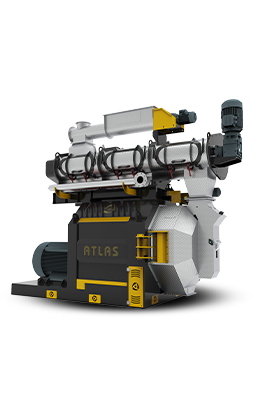
Gear-Driven (Direct Drive) Pellet Presses: Our high-pressure, gear-driven pellet presses transmit motor power to the rotor with 98% efficiency without loss. This mechanical authority in power transmission provides sharp savings directly reflected in invoices.
-
Rational Conditioner Optimization: Our twin-shaft conditioner units ensure steam penetrates the raw material homogeneously. A properly cooked formulation with adjusted moisture passes through the press die with minimal friction, completely eliminating capacity bottlenecks.
-
Next-Generation Automation: PLC and SCADA-supported drives (inverters) in our facilities adjust motor speed with digital precision based on the instantaneous raw material load.
Most Discussed Topic in Global B2B Agricultural Forums: "Increasing Motor Size vs. Optimizing Steam Pressure for Higher Capacity?" The most frequent dilemma debated by factory managers in industrial agricultural forums across the Middle East (Arab countries) and Africa is: "We need to increase our hourly pellet tonnage. Will replacing the main motor of our pellet press with a higher kW motor solve the problem?" Atlas Yem engineering provides a sharp response to this technical deadlock: Simply enlarging the motor enlarges your electricity bill, not your capacity. Before increasing motor power, you must enlarge the conditioner volume, extend the steam retention time, and maximize starch gelatinization. Forcing an undercooked material through the die by overloading the motor merely accelerates mechanical wear. True capacity increase and energy savings begin with thermodynamic optimization.
Total Cost of Ownership (TCO) and Holistic Plant Integration
In a turnkey feed mill installation, the pelleting line must be in perfect synchronization with the preceding crushing systems and mixing systems to operate in an energy-efficient manner. Using the wrong screen in the hammer mill (particles too coarse) or achieving insufficient homogeneity in the mixer directly chokes the pellet press.
While bringing Turkey's manufacturing discipline to the global arena, Atlas Yem zeroes out the energy-yield asymmetry of each unit strictly governed by ISO 9001:2015 standards. Our architecture, which provides 20% energy savings compared to traditional systems, places your enterprise in an unshakable position in regional market competition.
If you enjoyed our content "Energy Savings in Pelleting Processes" please visit our News page.
For more information, please contact us.
F.A.Q. (Frequently Asked Questions)
1. What is the most effective way to achieve energy savings in pelleting processes?
The most effective method is optimizing the steam quality (dry steam) and the retention time of the raw material in the conditioner unit. A properly cooked ration passes through the die with much less friction, instantly reducing the amperage drawn by the press motor.
2. How much energy do gear-driven pellet presses save compared to belt-and-pulley models?
Atlas Yem's gear-driven pellet presses eliminate slippage and friction losses in power transmission, providing direct mechanical energy savings of 10% to 15% compared to traditional models.
3. What precautions do you take against irregular power grids in Arab countries and Africa?
In geographies with weak electrical infrastructure, we equip our systems with low starting current drives (supported by soft starters and heavy-duty inverters). This protects the facility from grid fluctuations and prevents excessive energy consumption during motor startups.
4. Does the type of raw material (ration) directly affect energy consumption?
Yes. Rations with high fat content slide through the die easily, whereas rations heavy in roughage with high cellulose (fiber) content require higher mechanical pressure, thus increasing energy consumption.
5. How do automation systems save energy in the pelleting line?
By monitoring the material flow second by second via sensors, our SCADA systems prevent the machine from running idle. During moments of overloading, it autonomously reduces the feeding speed, preventing the motor from consuming unnecessary electricity.
People Also Ask (PAA)
-
How much is the electricity cost per ton in feed mills?
-
How many kW of electricity does a pellet press consume per hour?
-
How can energy consumption be reduced while increasing the Pellet Durability Index (PDI)?
-
What is the energy cost of flake feed technology compared to standard pelleting?