How to Construct a Feed Mill Turnkey | Atlas Yem
News
How to Construct a Feed Mill Turnkey
How to Construct a Feed Mill Turnkey: A Complete Step-by-Step Guide
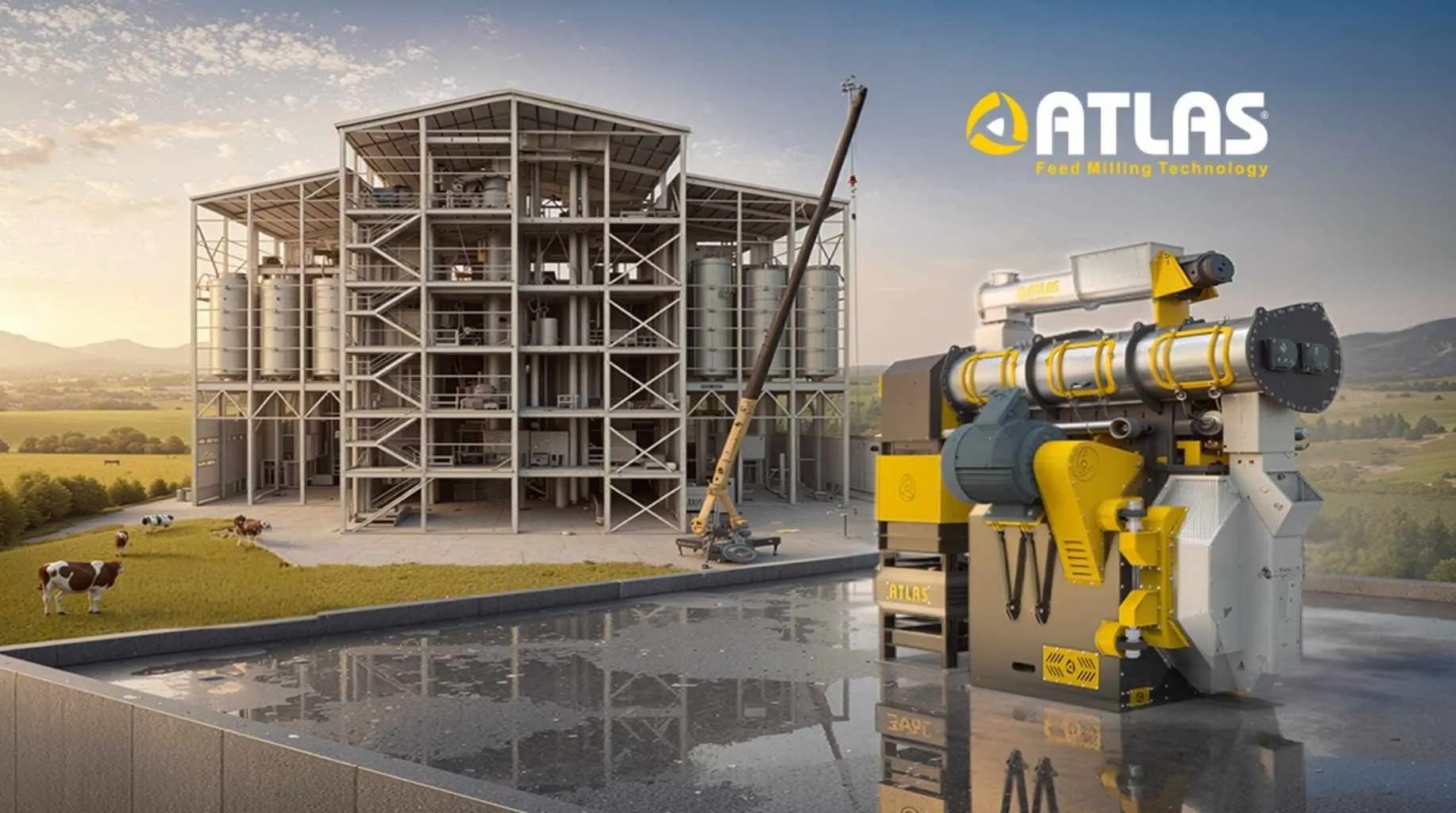
Constructing a feed mill turnkey means delivering a complete, operational feed production facility — from raw material intake to finished product packaging — through a single engineering contractor who designs, manufactures, installs, commissions, and trains in one integrated process. Atlas Yem has been delivering feed mill turnkey projects since 2002, combining ISO 9001:2015 certified manufacturing with 20+ years of field data from livestock feed facilities worldwide.
What Are the 7 Stages of a Feed Mill Turnkey Project?
A feed mill turnkey project follows a structured sequence that eliminates the costly surprises of a fragmented equipment approach:
- Stage 1 — Feasibility & Capacity Analysis: Define target output (tons/hour), ration formulas, raw material supply chain, and market requirements.
- Stage 2 — Site & Infrastructure Assessment: Soil survey, electrical capacity (kVA), water, gas, and logistics access.
- Stage 3 — System Design & Equipment Engineering: All 11 process groups — crushing through packaging — are designed as a synchronized ecosystem, not as independent machines.
- Stage 4 — Manufacturing: Every machine undergoes ISO 9001:2015 controlled load testing and vibration analysis before shipment.
- Stage 5 — Civil Construction & Mechanical Installation: Building structure and mechanical/electrical work run in parallel, reducing total project timeline.
- Stage 6 — Commissioning & Performance Testing: Real raw material trials, capacity verification, and parameter log documentation.
- Stage 7 — Operator Training & Warranty Period: On-site training for production staff; preventive maintenance plan activated.
What Process Systems Does a Complete Feed Mill Turnkey Include?
A modern feed mill turnkey project integrates 11 core feed technologies system groups. Atlas Yem engineers and installs all of them from a single source:
|
System Group |
Function |
Atlas Yem Equipment |
|---|---|---|
|
Crushing Systems |
Reduce raw material to optimum particle size |
Hammer mill + vibrating screen |
|
Dosing Units |
Precision weighing per ration formula |
Automatic dosing hoppers |
|
Mixing Systems |
Homogeneous feed blend production |
Twin-shaft / horizontal ribbon mixer |
|
Liquid Additive Equipment |
Fat, molasses, enzyme application |
Spray dosing systems |
|
Pelletizing Systems |
High-PDI pellet production |
Geared pellet press + conditioner |
|
Screening Systems |
Crumble and dust separation |
Vibration screens |
|
Ventilation (Cooling) |
Reduce pellet temperature and moisture |
Counter-flow cooler |
|
Transport Systems |
In-line material movement |
Bucket elevator + chain conveyor |
|
Routing Equipment |
Line direction and distribution |
Rotary valve + deflector |
|
Storage Systems |
Raw material and product silos |
Cylindrical and square silos |
|
Packaging Units |
Automatic bagging and labeling |
Automatic bagging unit |
Feed Mill Turnkey vs Equipment-by-Equipment: Which Is the Right Choice?
The most common dilemma for feed mill investors: build a turnkey feed mill through a single contractor, or source equipment from multiple suppliers? Atlas Yem's 20-year field data provides a clear answer.
|
Criterion |
Feed Mill Turnkey (Atlas Yem) |
Multi-Supplier Approach |
|---|---|---|
|
Integration Accountability |
Single point of responsibility |
Multiple vendors, diffused accountability |
|
Commissioning Timeline |
Faster — parallel processes |
Slower — coordination gaps |
|
Bottleneck Risk |
Eliminated at design stage |
Surfaces post-installation |
|
Energy Optimization |
Up to 20% system-wide savings |
Each machine optimized independently |
|
Warranty Management |
Single comprehensive warranty |
Separate warranties per machine |
|
Total Cost of Ownership (TCO) |
Modeled at project design stage |
Unpredictable |
|
ISO 9001:2015 Compliance |
Entire process documented |
Supplier-dependent |
Flake Technology and Recycling: Two Systems That Define Feed Mill Profitability
Why Does Flake Technology Matter in a Feed Mill Turnkey?
In cattle and poultry production, starch digestibility directly determines the Feed Conversion Ratio (FCR). Atlas Yem feed mill Flake Technologies process grains through high-temperature Steam Chests that soften the cell membrane, then roll them to the ideal micron thickness in heavy-duty Flaking Mills. This raises starch digestibility above 90% — meaning more milk and meat output per kilogram of feed.
- Flake Waltzes (Rollers): Homogeneous thickness, zero particle scatter
- Flake Steam Tower (Steam Chest): Optimum conditioning time and pressure
- Flake Drying Systems: Moisture control for extended shelf life
- Crushing Systems: Adjustable roll gap for different grain profiles
Why Are Recycling Technologies Essential in a Feed Mill Turnkey?
Off-spec pellets, crumbles, and process dust represent direct raw material loss when not recovered. Atlas Yem Feed mill Recycling Technologies convert these by-products back into productive inputs — a critical component of any turnkey feed mill designed for profitability:
- Shedder: Breaks large-format items into processable pieces
- Recycling Crusher Machine: Reduces crumbles to optimum particle size
- Recycling Package Opening Machine: Feeds returned bagged product back into the system
- Trommel Sieve: Fractionates by particle size for clean separation
Plant Manager Experience — Cattle Feed Mill, Central Turkey
"Our first attempt used equipment from four different suppliers. We had a chronic capacity mismatch between the pellet press and the cooler that cost us weeks of lost production. When we commissioned Atlas Yem's feed mill turnkey, that problem had already been solved at the design table. Our energy cost per ton dropped 17% in year one."
Frequently Asked Questions - FAQ
What is the minimum viable capacity for a commercial feed mill turnkey?
Commercial viability typically begins at 5–10 tons per hour. Below this threshold, fixed infrastructure costs (silos, utilities, civil works) are difficult to amortize. Atlas Yem designs feed mill turnkey projects from small farm-scale units to large industrial complexes — capacity is determined through feasibility analysis based on target market, raw material access, and financing conditions.
How long does a feed mill turnkey project take from contract to commissioning?
A standard feed mill turnkey project takes 6–18 months from contract signing to commissioned production, depending on civil construction scope, local permitting timelines, and equipment complexity. Atlas Yem's parallel execution model — where civil construction and equipment manufacturing run simultaneously — reduces this timeline by 20–30% compared to sequential approaches.
What is Pellet Durability Index (PDI) and why does it matter?
PDI measures the percentage of pellets that survive handling and transport without crumbling. A PDI above 95% is the commercial standard. Low PDI causes dusty feed, selective eating by animals, and elevated waste. Atlas Yem's geared pellet press with steam conditioning consistently achieves PDI above 95%, reducing feed loss and improving animal intake consistency.
What automation level should a feed mill turnkey include?
PLC and SCADA integration is now the baseline for any competitive feed mill turnkey. Atlas Yem implements centralized monitoring of all line parameters — conditioning temperature, pellet press load, cooler moisture, and dosing accuracy. This prevents unplanned downtime, reduces maintenance costs by 25–35%, and ensures ration consistency across every production batch.
Does Atlas Yem provide after-sales support for feed mill turnkey projects?
Yes. Atlas Yem provides original spare parts, remote diagnostics, on-site technical service, and periodic maintenance packages throughout the machine lifetime. ISO 9001:2015 certification covers the after-sales service process — not just manufacturing. Field engineers are available for emergency intervention to protect production continuity during peak livestock seasons.
People Also Ask (PAA)
What is the difference between a pellet mill and a flaking mill in a feed plant?
A pellet mill compresses conditioned mash through a die to produce cylindrical pellets — the standard form for poultry and small ruminant feed. A flaking mill rolls steamed whole grains between two rolls to produce flat flakes — optimized for cattle rations requiring maximum starch digestibility. Most industrial feed mill turnkey projects include both.
What raw materials can a turnkey feed mill process?
A standard feed mill turnkey handles corn (maize), wheat, barley, sorghum, soybean meal, sunflower meal, and various mineral and vitamin premixes. Specialized lines can process oilseeds, legumes, and by-products. Atlas Yem designs the crushing, dosing, and mixing specifications around the specific raw material portfolio of each client.
How is total cost of ownership (TCO) calculated for a feed mill turnkey?
TCO for a feed mill turnkey includes capital expenditure (CAPEX), annual energy cost, scheduled maintenance, spare parts consumption, and labor. Atlas Yem models TCO at the project design stage using real operational data from comparable facilities — providing a transparent investment table before commitment. This approach consistently delivers payback periods below industry average.
If you enjoyed our content "How to Construct a Feed Mill Turnkey" please visit our News page.
For more information, please contact us.