6 Ways to Reduce Feed Mill Energy Consumption by 20%
News

6 Ways to Reduce Feed Mill Energy Consumption by 20%
6 Ways to Reduce Feed Mill Energy Consumption by 20%: Atlas Yem Engineering
In modern industrial livestock and feed production, the most critical metric determining profitability is the production cost per ton. As Turkey-based Atlas Yem, a recognized authority in the global market—including Arab countries and Africa—we observe an unwavering truth in our turnkey feed mill projects: The largest operational cost item is not raw materials, but energy consumption. Especially in the feed technologies sector, pelletizing and crushing processes consume more than 60% of a facility's total electricity.
Backed by engineering expertise since 2002, we explain with surgical precision how to eliminate energy bottlenecks and reduce energy consumption in a feed production plant by up to 20% through 6 rational steps.
Rational Energy Optimization in Pelletizing and Crushing Systems
Use of High-Efficiency Motor Drives (Inverters)
In traditional feed plants, motors run continuously at full capacity. This creates massive energy waste, especially during load fluctuations. The new generation vector-controlled inverters used in Atlas Yem's pelletizing systems and crushing systems optimize motor speed with digital precision according to the instantaneous load. By lowering starting currents, this system alone provides 8-12% energy savings.
The Authority of Geared Pellet Presses
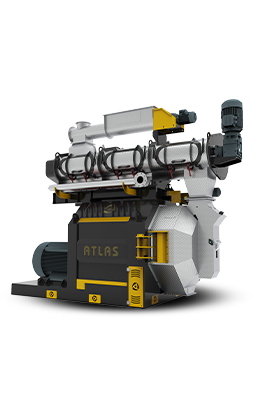
Traditional belt-driven pellet presses lose 5-10% of energy as heat due to friction and slipping. Atlas Yem's direct-drive (geared) pellet presses transmit motor power to the rotor with 98% efficiency. This mechanical architecture, proactively minimizing energy loss, dramatically pulls down the pelleting cost per ton.
Steam Quality and Conditioner Optimization
If adequate starch gelatinization is not achieved in the conditioner units (steam cooking) prior to pelleting, the pellet press motor is forced to draw higher amperage. Atlas Yem engineering utilizes rational steam dosing valves and twin-shaft conditioners to bring the feed to the optimal moisture and temperature, reducing the mechanical strain on the press and lowering electricity usage.
Most Discussed Topic in Global B2B Forums: "The Inverse Proportion Between Screen Diameter and Energy Consumption in the Crushing Process" The most common dilemma faced by feed producers on B2B platforms is: "We want finer grinding, but our hammer mill is consuming too much electricity; what should we do?" As Atlas Yem, we give a sharp answer to this technical bottleneck: Two-stage crushing or rational screen design. Simply reducing the screen diameter chokes the motor and turns energy into heat. Instead, you should use aspirator (ventilation) assisted crushing systems to ensure that crushed particles are evacuated from the chamber in seconds. Atlas Yem's aerodynamic crushing design guarantees the same fineness of product with 15% less energy.
The Impact of Full Automation and Logistics Ecosystem on Energy
PLC/SCADA Based Uninterrupted Flow Management
A feed machine can consume 30-40% of its nominal energy even when running empty. In fully automated facilities built by Atlas Yem, material flow is monitored by sensors. For example, when mixing systems finish processing or transport systems empty out, the system instantly puts the relevant motors into sleep mode. This "smart synchronization" zeroes out wasted kW.
Energy/Yield Asymmetry with Flake Technology
Flake technologies condition grains in steam towers (Steam Chest) and crush them in rollers, increasing digestibility to over 90%. While steam costs may seem high at first glance, the milk and meat yield obtained from the animal increases so sharply that the "energy cost per unit of animal food produced" drops massively. Atlas Yem flake plants are the pinnacle of profitability in terms of ROI.
Correctly Projected Elevator and Conveyor Network
When in-plant transport systems (elevators and screw conveyors) are poorly projected (excessive steep angles, incompatible gearbox selections), huge energy losses occur due to friction. Designed with Konya's manufacturing discipline, Atlas Yem logistics lines rationally utilize gravity to minimize the kW values of transfer motors.
If you enjoyed our content "6 Ways to Reduce Feed Mill Energy Consumption by 20%" please visit our News page.
For more information, please contact us.
F.A.Q. (Frequently Asked Questions)
1. Can I achieve 20% energy savings just by changing the pellet press?
Replacing just the pellet press with a new-generation geared Atlas Yem machine provides 10-15% savings. To reach the full 20% rate, steam optimization (conditioner) and automation updates are also required.
2. Don't recycling lines (Shedder, etc.) create extra energy costs?
On the contrary. Crushing defective pellets with recycling technologies (Shedder) uses far less energy than putting that product back through the hammer mill from scratch. It creates net profitability by providing waste-free return to the system.
3. Does Atlas Yem build energy-efficient installations in Africa and Arab countries?
Yes. For the Arab countries and African markets, where grid electricity can be unstable or generator use is common, we produce specialized turnkey projects with low starting currents and extra automation protection.
People Also Ask (P.A.A.)
-
How much is the electricity cost per ton in a feed mill?
-
How does steam pressure affect energy in the pelleting process?
-
What is the energy consumption difference between a hammer mill and flaking mills?
-
How much electricity do PLC automation systems save in feed plants?