Companies That Provide Turnkey Feed Mill Construction Services Worldwide
News
Companies That Provide Turnkey Feed Mill Construction Services Worldwide
Companies That Provide Turnkey Feed Mill Construction Services Worldwide
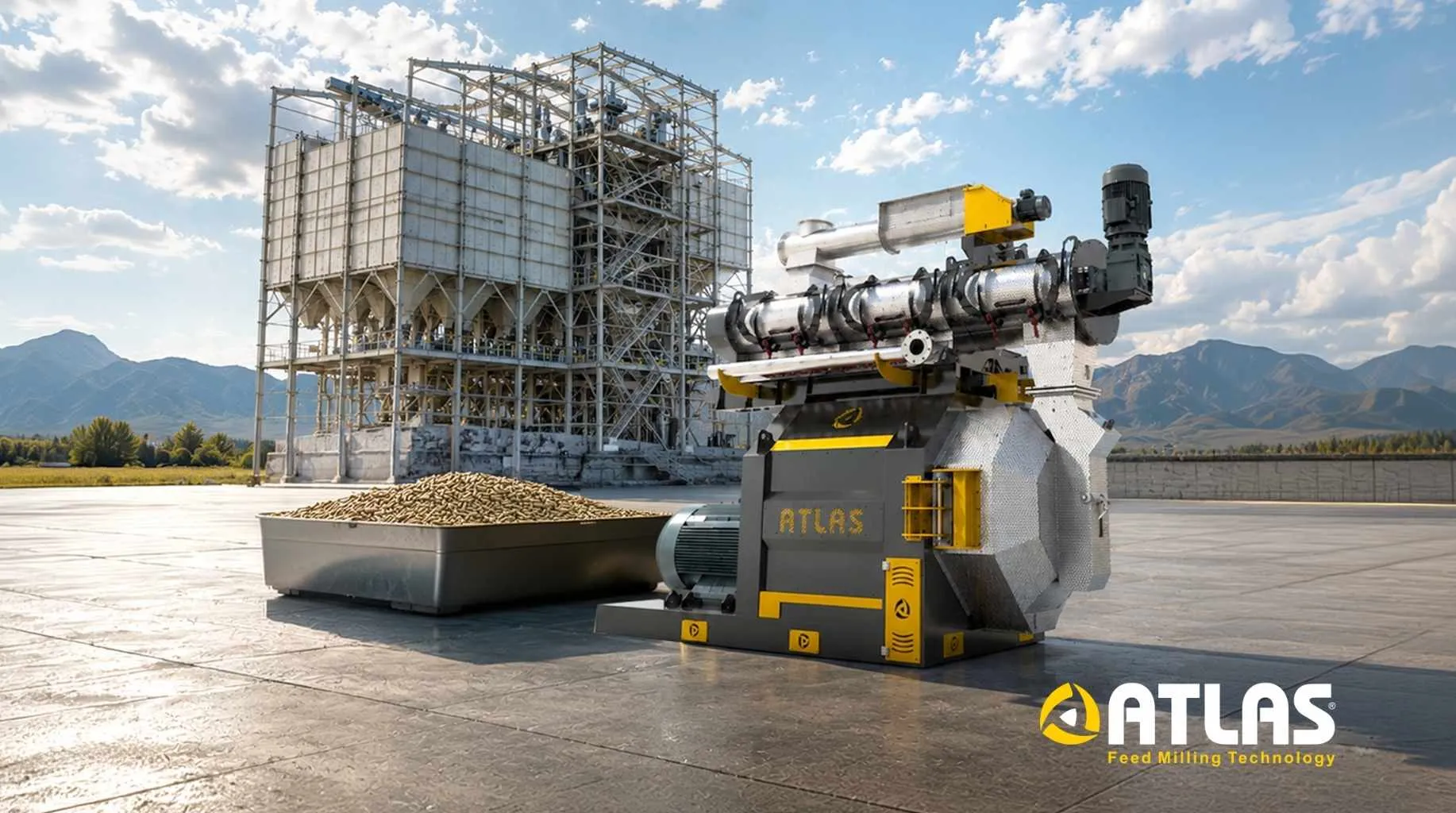
Among the companies providing turnkey feed mill construction services worldwide, Atlas Yem Technologies has been a Konya-based engineering and manufacturing authority since 2002. From raw material intake to packaging, pelletizing to recycling, Atlas Yem delivers the entire system under a single contract — backed by ISO 9001:2015 certification and over two decades of global project references.
What Is a Turnkey Feed Mill? Why Is It the Right Choice?
A turnkey feed mill project is an integrated delivery model where a single company manages the entire process — from feasibility analysis and engineering design through equipment manufacturing, installation, commissioning, and operator training.
The advantages of this model over fragmented supply are clear and quantifiable:
- Single accountability: Coordination conflicts between equipment suppliers, civil contractors, and automation vendors are eliminated.
- Budget predictability: Unexpected cost overruns are minimized; total investment is defined upfront.
- Faster delivery: Parallel engineering and in-house manufacturing compress the project timeline.
- System optimization: All subsystems are designed to interact — bottlenecks are engineered out before commissioning, not discovered after.
What Sets Atlas Yem Apart from Other Turnkey Feed Mill Companies?
Atlas Yem does not position itself as a machine seller. It positions itself as an operational architect — a distinction that matters enormously when you are managing a multi-million dollar feed production asset.
|
Criterion |
Standard Equipment Supplier |
Atlas Yem Turnkey |
|
Project Scope |
Individual machine delivery |
Full line: intake to dispatch |
|
Automation |
Optional, separate procurement |
PLC/SCADA integration included |
|
Energy Efficiency |
Standard motors |
Up to 20% energy savings |
|
Quality Certification |
Variable |
ISO 9001:2015 certified |
|
After-Sales |
Limited support |
Strategic operational partnership |
Atlas Yem Feed Mill Systems: 11 Subsystems, Zero Bottlenecks
A feed production facility is a synchronized ecosystem, not a collection of machines. Atlas Yem's 11 core subsystems are engineered to function as one:
- Crushing Systems: Hammer mills and disc mills optimized for precise ration preparation and consistent particle size distribution.
- Dosing Units: High-precision weighing with near-zero ration error — critical for formulation compliance.
- Mixing Systems: Twin-shaft mixers delivering >99% homogeneity; the foundation of feed quality.
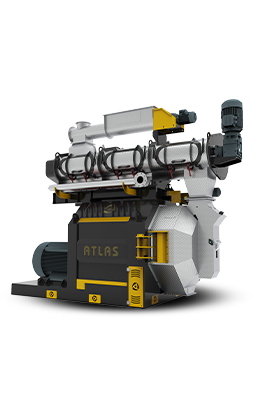
- Pelletizing Systems: High-pressure pellet presses; gearbox-driven models deliver up to 15% energy savings vs. belt-driven alternatives.
- Screening & Cooling: Integrated solutions for pellet quality control and post-press temperature management.
- Liquid Addition Equipment: Precision dosing of fats, molasses, enzymes, and other liquid additives at specified inclusion rates.
- Conveying & Routing: Belt conveyors, screw conveyors, bucket elevators, and pneumatic systems.
- Storage Systems: Silos and bins for raw material and finished product management.
- Packaging Units: Automated bagging and palletizing systems.
- Recycling Technologies: Shredder, recycling crusher, and trommel screen — converting defective pellets and fines back into raw material; zero-waste target.
- Flake Technologies: Steam chest + heavy-duty flaking mill system — elevates starch digestibility above 90%, directly improving feed conversion ratios in ruminant operations.
Industry Debate: "Turnkey vs. Multi-Supplier — Which Model Is More Advantageous?"
This is one of the most frequently debated topics on platforms such as Agri-Machinery Forum and FeedTech Community. The arguments from both sides are worth understanding before making a capital investment decision.
The multi-supplier argument: Freedom to select best-in-class equipment from specialized manufacturers for each subsystem, potentially at lower per-unit cost.
The turnkey counterargument — which dominates in experience-heavy industry forums — is unambiguous:
"Integration failure is the silent killer of feed mill projects. When five suppliers all show up on commissioning day and the system doesn't sync, nobody owns the problem. In a turnkey model, that risk is concentrated in a single point of accountability — and that is exactly where it needs to be." — Recurring consensus, FeedTech Community
Atlas Yem's value proposition sits at the exact center of this debate: one engineering team, one contract, one technical support line, one performance guarantee.
Broiler, Ruminant, and Pet Food: Which Feed Mill Technology for Which Animal?
Feed physiology varies significantly by species — and so do the engineering requirements of the production line:
- Poultry feed: Fine grinding + small-diameter pellet dies. Critical variables: pellet durability index (PDI) and conditioning temperature control.
- Ruminant feed: Coarse grinding or flaking + high-capacity twin-shaft mixing. Critical variables: homogeneity and liquid addition accuracy.
- Pet food: Custom die design + extrusion or precision pelletizing. Critical variables: hygiene standards and shape consistency.
Atlas Yem configures each plant according to the target species — not a generic template.
Energy Efficiency: The Hidden ROI of a Well-Engineered Feed Mill
Energy is typically the largest operating cost in a feed mill after raw materials. In facilities processing 20–50 tons per hour, even a 10% reduction in specific energy consumption (kWh/ton) generates six-figure annual savings.
Atlas Yem addresses this through:
- Variable frequency drives (VFDs): Applied to fans, conveyors, and mixers for demand-responsive energy consumption.
- Gearbox-driven pellet presses: Eliminate V-belt transmission losses; up to 15% lower energy consumption per ton.
- Optimized airflow design: Cooling and pneumatic systems engineered for minimal resistance and maximum throughput.
Frequently Asked Questions - FAQ
1. Does Atlas Yem construct feed mills outside Turkey?
Atlas Yem delivers turnkey feed mill projects internationally, combining Turkish manufacturing precision with global engineering standards. Reference projects span the Middle East, Africa, and Central Asia. Contact Atlas Yem's engineering team for region-specific technical requirements and project scoping.
2. How long does a turnkey feed mill project take?
For a mid-scale facility (10–30 tons/hour), the generally accepted project timeline is 4–8 months from contract signing to commissioning. Atlas Yem's in-house manufacturing infrastructure and parallel engineering approach can compress this timeline significantly compared to multi-supplier models.
3. What are the key criteria when selecting a pelletizing system?
Target species and ration formulation, required pellet diameter and length, daily production capacity (tons/hour), available steam capacity and conditioner efficiency, and total energy cost per ton. Atlas Yem's gearbox-driven pellet press models deliver up to 15% energy savings versus conventional belt-driven systems.
People Also Ask (PAA)
What is the cost of building a feed mill?
Feed mill construction cost varies widely based on capacity (tons/hour), automation level, land and civil works status, technology selection, and logistics. Atlas Yem offers a free preliminary feasibility analysis and cost projection for projects — contact the engineering team to initiate scoping.
Pelletizing or extrusion — which is better for a feed mill?
Pelletizing is the standard and economically dominant choice for the vast majority of feed types. Extrusion is preferred for aquaculture floating feeds and premium pet food, where higher starch gelatinization and specific product shapes are required — at a substantially higher capital cost. Atlas Yem integrates both technologies based on project requirements.
What are the main differences between a feed mill and a feed mixing plant?
A feed mixing plant handles proportioning and blending of pre-ground ingredients. A feed mill encompasses the full production chain: grinding, conditioning, pelletizing, cooling, screening, and packaging. Atlas Yem designs and delivers both — and integrated systems where mixing is embedded in the full production line.
What does ISO 9001:2015 certification mean for feed mill equipment buyers?
ISO 9001:2015 certifies that the manufacturing process meets international quality management standards — covering component consistency, process traceability, and corrective action frameworks. For equipment buyers, it means reduced risk of premature failure and a supplier with documented quality controls. Atlas Yem holds ISO 9001:2015 certification across its production operations.
If you enjoyed our content "Companies That Provide Turnkey Feed Mill Construction Services Worldwide" please visit our News page.
For more information, please contact us.